
Functional Medicine Health Coach: Understanding Root Cause Healing
When I first started learning about a functional medicine health coach, one idea completely changed the way I think about health: symptoms are often signals, not the root problem.
Quick Look: Root Cause Healing in Functional Medicine
Functional medicine looks beyond symptoms
Focuses on identifying root causes
Uses personalized, whole-body approaches
Explores stress, inflammation, gut health, and lifestyle patterns
Encourages partnership between practitioner and patient
For so long, I though symptoms were sometimes just the issue. Headaches, fatigue, digestive problems, anxiety; you treat the symptom and move on.
But functional medicine approaches things differently.
Instead of only asking: What symptoms are we treating?
It asks: Why is this happening in the first place?
And honestly? That question changed everything for me.
As I continue learning and working toward becoming a functional medicine health coach, I’ve started to understand why so many people feel frustrated when they continue managing symptoms without ever feeling truly better.
This post may contain affiliate links, which means I may earn a small commission at no extra cost to you.
How Functional Medicine Differs from Conventional Medicine
Traditional medicine is incredibly important, especially in emergencies and acute illness. But when it comes to chronic symptoms, many people still end up feeling stuck.
Functional medicine takes a different approach.
Instead of only focusing on managing symptoms, it looks deeper to ask: “What might contributing to these symptoms in the first place?”
That’s where the idea of root cause healing comes in.
This approach is heavily influenced by the work of the Institute for Functional Medicine, which focuses on systems biology, personalized care, and understanding the body as one connected system.
If you missed my earlier posts on understanding the Functional Medicine Matrix in simple terms and how I’m learning systems biology in functional medicine health coaching, they help explain why the body needs to be viewed as a connected system instead of isolate symptoms.
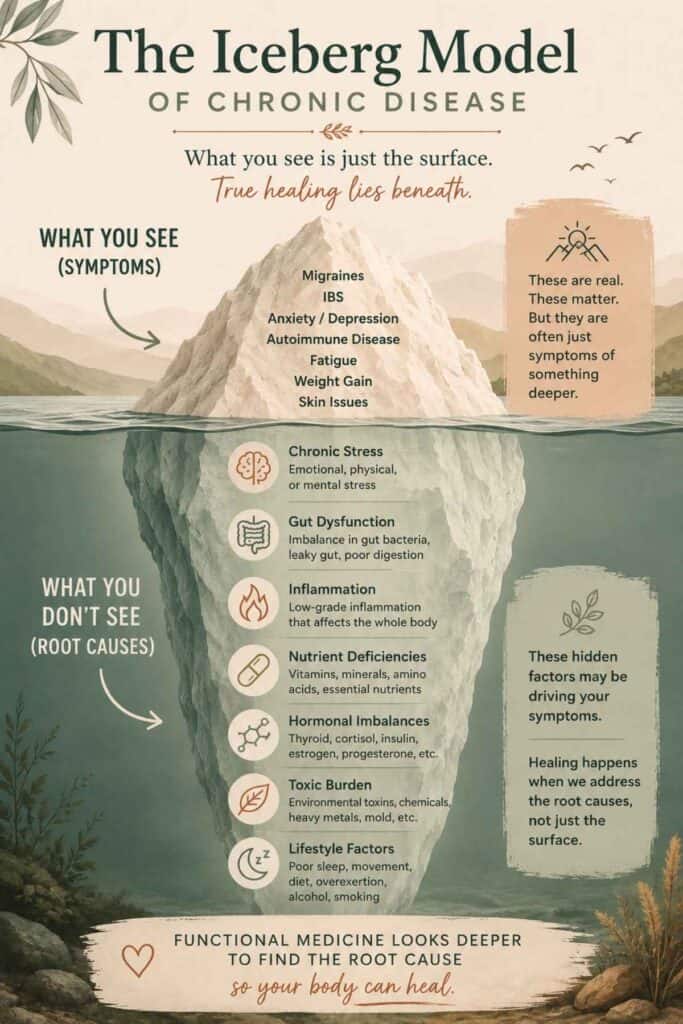
The Iceberg Model of Chronic Disease (Made Simple)
One of the easiest ways to understand functional medicine is through something called the iceberg model.
The visible symptoms are the part above the water.
Things like:
- migraines
- IBS
- anxiety
- fatigue
- autoimmune disease
But underneath the surface, there may be deeper imbalances contributing to those symptoms.
Things like:
- chronic stress
- inflammation
- gut health imbalances
- nutrient deficiencies
- hormone disruptions
Functional medicine focuses on exploring what may be happening beneath the surface instead of only reacting to what’s visible.
This is also why so many people can feel frustrated when they are trying to eat healthier, sleep better, or reduce stress but still don’t feel well. I talked more about this in my post on why you still don’t feel better and what helps because symptoms are often connected to deeper patterns happening beneath the surface.
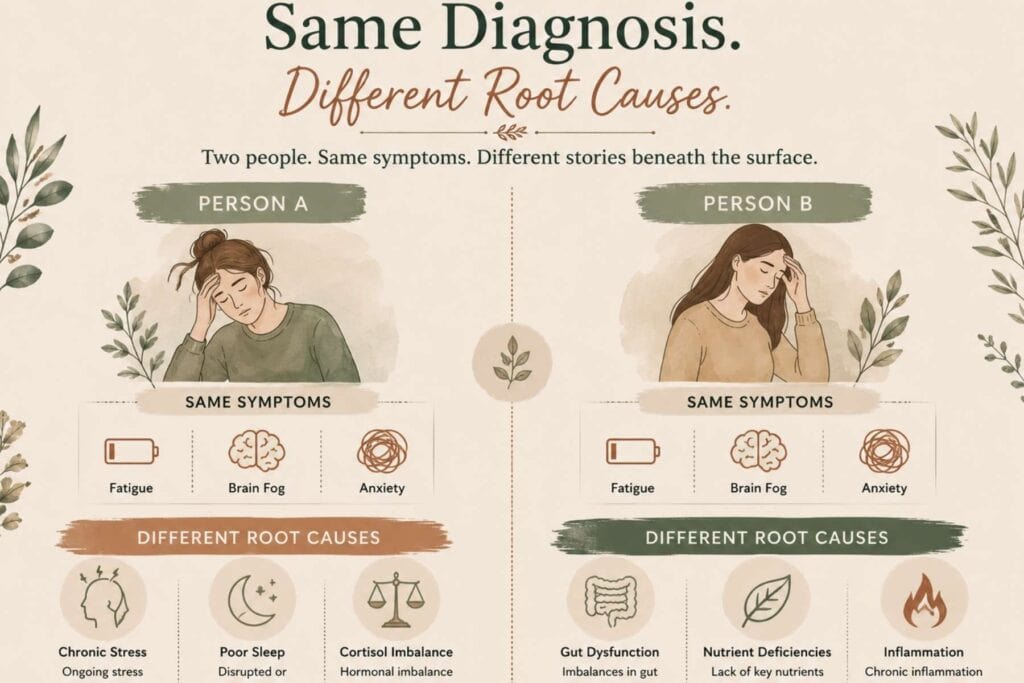
Why Two People with the Same Diagnosis Can Feel Completely Different
One thing I’m learning is that two people can have the exact same diagnosis and still have completely different root causes behind it.
For example, two people struggling with fatigue or depression may both feel exhausted, but the “why” underneath could look completely different.
One person may be dealing with chronic stress. Another may have gut imbalances or nutrient deficiencies. Another may be struggling with hormone dysfunction or inflammations.
That’s why functional medicine focuses so heavily on personalized care instead of one-size-fits-all solutions.
Why One Root Cause Can Affect Multiple Systems
The opposite can also happen.
One underlying imbalance may contribute to several seemingly unrelated symptoms at the same time.
For example, chronic inflammation may impact:
- digestion
- mood
- energy levels
- hormones
- cardiovascular health
Research continues to show how deeply connected inflammation is to overall wellness and chronic disease. Cleveland Clinic explains chronic inflammation here.
Functional medicine tries to look for those shared underlying patterns instead of viewing every symptom separately.
The Therapeutic Partnership Model in Functional Medicine
One of the things I appreciate most about functional medicine is the shift from authority-based care to partnership-based care.
In this model:
- the practitioner guides
- the client participates actively
- decisions are collarborative
- education encourages long-term behavior change
This matters because healing doesn’t usually happen from information alone.
It often requires:
- support
- consistency
- lifestyle changes
- accountibility
- understanding your own body better
As I train to become a functional medicine health coach, I’m learning that coaching often helps bridge the gap between knowing what to do and actually implementing it in real life.
Why Root Cause Healing Matters
Functional medicine aims to support better long-term outcomes by focusing on the factors that may be contributing to dysfunction in the first place instead of only managing symptoms.
That can include things like:
- stress
- nutrition
- sleep
- movement
- inflammation
- gut health
- environmental exposures
Emerging research on the gut microbiome and overall health continues to reinforce how interconnected the body truly is.
Chronic stress can also impact nearly every system in the body, including sleep, hormones, and inflammation. Mayo Clinic explains the effect of chronic stress here.
The more I learn, the more I realize that healing often requires looking at the bigger picture.
Why This Philosophy Matters in My Health Coaching Journey
Studying functional medicine has completely reshaped how I think about healing.
I no longer see the body as “broken.”
I see it as a body constantly responding and adapting to stress, environment, nutrition, lifestyle, and life experiences.
And sometimes symptoms are simply the body’s way of asking us to pay attention.
As I continue learning and working towards becoming a functional medicine health coach, my goal is to help people feel more informed, more empowered, and more connected to their own health story.
Because healing isn’t always about chasing symptoms.
Sometimes it starts with understanding what your body may have been trying to say all along.
Wellness Resources I’ve Been Loving Lately
As I continue learning more about functional medicine and whole-body wellness, I’ve been trying to focus on small daily habits that support stress management, sleep, movement, and creating a healthier environment overall.
These are a few simple wellness tools I’ve personally been loving lately and thought I’d share in case they help support wellness journey too.
Blue Light Glasses: I mainly use these all day while I am at work or editing blog posts. While research on blue light glasses is still mixed, many people find them helpful for reducing digital eye discomfort and creating better evening screen habits. For me personally, it has helped with eye strain and headaches.
Herbal Stress Support tea: This kind of tea has become one of my favorite little evening rituals. It feels grounding, calming, and honestly just reminds me to slow down for a few minutes.
Walking Pad for Daily Movement: One thing I’m learning more and more is that movement does not have to be extreme to matter. Sometimes simple daily walks and consistent movement habits are more sustainable than trying to do everything perfectly.
Air Purifier: I’ve also become more aware of how our environment can impact how we feel overall. Creating a cleaner, calmer home environment has become something I’m paying for attention to lately.
Root cause healing focuses on identifying and addressing the underlying factors contributing to symptoms instead of only managing symptoms themselves.
Functional medicine looks at the body as one connected system and explores possible contributors like stress, inflammation, gut health, and lifestyle patterns.
A functional medicine health coach helps support behavior change, accountability, wellness habits, and lifestyle implementation alongside healthcare providers.
Two people with the same diagnosis may have completely different underlying contributors. Functional medicine aims to create more individualized support and wellness strategies.

Wellness Disclaimer: I’m currently learning and training in functional medicine health coaching and sharing my educational journey along the way. This content is not intended to diagnose or replace medical advice. Always speak with a qualified healthcare professional regarding your health concerns.
